Skip to content

SteveStedman

Using SQL Server Compressed Backups

The Quick Scan report in Database Health Monitor detects when you are performing SQL Server backups without compression, when the compression option is available. This applies to Full backups, Transaction log backups and Differential backups.

Not using compressed backups? Why not?

Benefits of compressed backups

  • Faster backup time
  • Faster restore time
  • Less I/O at backup and restore time
  • Since you are using less disk space, you can keep more backups around.

There are a couple minor drawbacks, the compressed backups take more CPU, not much more, but a tiny bit more.  Also the compressed backups don’t compress very much when your database is using Transparent Data Encryption (TDE).
Read More »Using SQL Server Compressed Backups

Max Server Memory – SQL Server

Max Server Memory Setting Explained

If you have more memory than your database and applications on the SQL Server will ever use than this is not a problem, but when you run into memory constraints this setting is much more important.

SQL Server attempts to use as much memory as possible, and when there is no more memory available, SQL Server will use much more I/O due to data and index pages having to be read from disk more often. This works great for SQL Server, but what happens is that SQL Server will take almost all the memory leaving very little for the operating system processes or other applications that are running.

The default for this setting is 2147483647 which is probably more memory that your server has, which effectively tells SQL Server to take as much memory as it wants to.

Read More »Max Server Memory – SQL Server

Presenting at SQL Saturday Las Vegas

This Saturday, September 12th, 2015 I will be presenting at SQL Saturday Las Vegas. My presentation is on Database Corruption, here are the details.

When Database Corruption Strikes – Will you be ready?

Duration: 60 minutes

Track: Enterprise Database Administration & Deployment

You are working along month after month with no problems in your database. Suddenly someone reports that their query won’t run. They get an error stating “SQL Server detected a logical consistency-based I/O error“, or something even scarier. Do you know what to do now? We will walk through 3 or 4 actual corrupt databases exploring ways to go about finding and fixing the corruption. More importantly we will explore how to prevent further data loss at the time corruption occurs. Learn what things you should do to protect yourself when corruption strikes. Learn what to avoid that will make things worse. You will leave with a checklist of steps to take when you encounter corruption. By the end of this session you will be ready to take on corruption, one database at a time.

SQL Saturday Las Vegas

The presentation is scheduled for 11:00 am to Noon in room 2767 at the College of Southern Nevada campus in Vegas.

Read More »Presenting at SQL Saturday Las Vegas

mssqlsystemresource Database

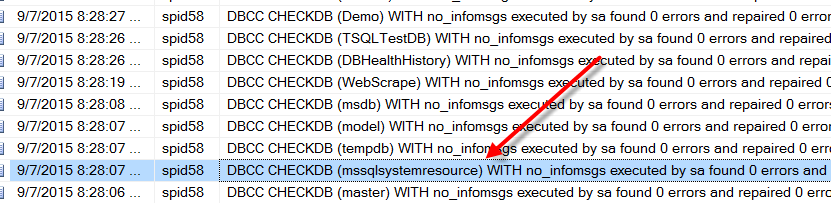
I was looking through my SQL Server error logs to confirm that CheckDB was being run as I had scheduled based on my previous post to run DBCC CheckDB on all databases. I wanted to confirm that there was no corruption, and that all of the databases had been checked, and not had been missed. Going through this I noticed the logging of all of my databases, but one extra database showed up, the mssqlsystemresource database.

mssqlsystemresource database

Now the mssqlsystemresource database is an internal SQL Server database that is used by SQL Server, it also gets replaced by SQL Server when you do an upgrade of your SQL Server database. It is hidden so that people don’t have access to it, and it doesn’t show up when you run the undocumented sp_msforeachdb it doesn’t include the mssqlsystemresource database. Additionally the sys.databases view doesn’t include the mssqlsystemresource database.

Read More »mssqlsystemresource Database

Status of DBCC CheckDB

So you are checking your database with DBCC CheckDB and of course if you are like me you use the WITH NO_INFOMSGS parameter. But it turns out that CheckDB is taking longer to run that you expected, and you want to check and see what table is currently being checked.

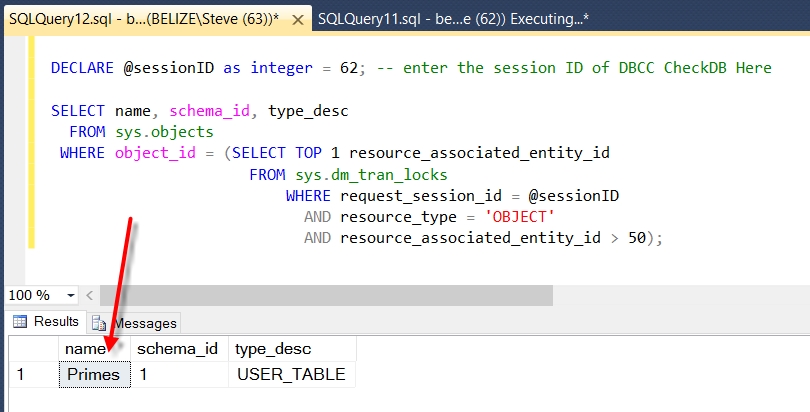
Here is a quick SQL Script that I use to find the current table that is being checked by DBCC CheckDB

use [your database];
go

-- use this to find the session id of DBCC CheckDB
SELECT session_id, start_time, command, percent_complete, total_elapsed_time,
       estimated_completion_time, database_id, user_id, last_wait_type
  FROM sys.dm_exec_requests
 CROSS APPLY sys.dm_exec_sql_text(sql_handle)
 WHERE command like '%DBCC%';  

DECLARE @sessionID as integer = 53; -- enter the session ID of DBCC CheckDB Here

SELECT name, schema_id, type_desc
  FROM sys.objects
 WHERE object_id = (SELECT TOP 1 resource_associated_entity_id
                      FROM sys.dm_tran_locks
					 WHERE request_session_id = @sessionID
					   AND resource_type = 'OBJECT'
					   AND resource_associated_entity_id <> 50);

status of dbcc checkdb

Read More »Status of DBCC CheckDB