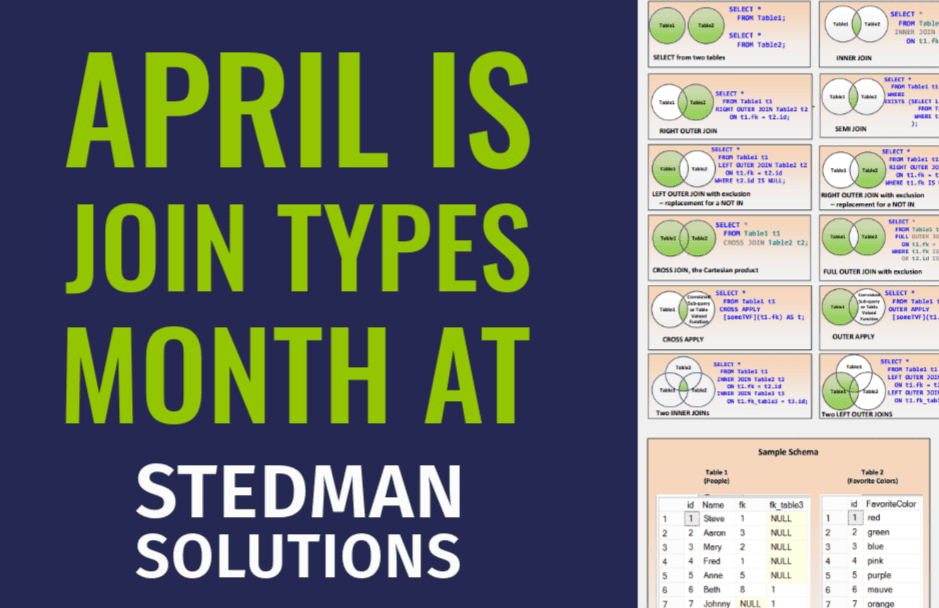
April Promo Join Types Poster
Welcome to April at Stedman Solutions, LLC! This month, we’re excited to announce that April is JOINS month, where all our promotions and activities will… Read More »April Promo Join Types Poster
Blog posts relating to SQL Performance Tuning.
SQL Server tuning is the process of optimizing the database’s configuration, queries, and infrastructure to ensure the system runs as efficiently as possible. The goal is to reduce resource usage, increase query speed, and improve overall system responsiveness. Performance tuning involves analyzing server performance metrics, identifying bottlenecks, and implementing solutions that range from hardware upgrades to query rewriting. These optimizations are crucial for maintaining a smooth user experience and supporting business-critical applications.
A key aspect of performance tuning is query optimization. Poorly written SQL queries, missing indexes, or incorrect indexing strategies often lead to slow query execution. By using tools such as execution plans and SQL Profiler, DBAs can identify and correct inefficiencies in SQL code. Techniques like index tuning, query rewriting, and partitioning can drastically reduce query execution times. Regularly updating statistics and reorganizing or rebuilding indexes further enhances query performance and ensures accurate query plans.
Beyond queries, performance tuning also focuses on the SQL Server environment itself. Configuring server settings, adjusting memory allocation, and fine-tuning I/O operations play a significant role in optimizing database performance. Monitoring tools like Database Health Monitor (available at DatabaseHealth.com) provide insights into server health and potential issues. Stedman Solutions offers comprehensive SQL Server performance tuning services, combining years of experience with specialized tools to ensure your SQL Server environment performs at its peak. Learn more about our managed services at Stedman Solutions.
Welcome to April at Stedman Solutions, LLC! This month, we’re excited to announce that April is JOINS month, where all our promotions and activities will… Read More »April Promo Join Types Poster

Welcome to April at Stedman Solutions, LLC! This month, we’re excited to announce that April is JOINS month, where all our promotions and activities will… Read More »My Join Types Course

Wait statistics, in the context of SQL Server, refer to the amount of time that a query spends waiting to access data in the database.… Read More »SQL Server Wait Type: PREEMPTIVE_OLEDBOPS

Each month we report on the most common waits that we see reported by our daily monitoring customers. All the data is sanitized, so there… Read More »Common Waits Reported by Daily Monitoring This Month

Welcome to April at Stedman Solutions, LLC! This month, we’re excited to announce that April is JOINS month, where all our promotions and activities will… Read More »Join Types Shirt

Push vs Pull, Here is a short video that I created explaining the difference between Push and Pull replication in SQL Server. Watch it on… Read More »Push vs Pull Replication Video

Welcome to April at Stedman Solutions, LLC! This month, we’re excited to announce that April is JOINS month, where all our promotions and activities will… Read More »Join Types on your wall

In addition to its customizable dashboard, intelligent alerting system, and powerful reporting capabilities, the Database Health Monitor also provides valuable insights into wait statistics and… Read More »Database Health: Wait Statistics and Blocking Queries
Welcome to April at Stedman Solutions, LLC! This month, we’re excited to announce that April is JOINS month, where all our promotions and activities will… Read More »Don’t Miss Out With Join Types Month
Hey there, fellow SQL enthusiasts! I’m Steve Stedman, and I’m excited to share my SQL Server course on the TSQL Output Clause. If you’re like… Read More »SQL School: Master the TSQL Output Clause with My SQL Server Course